

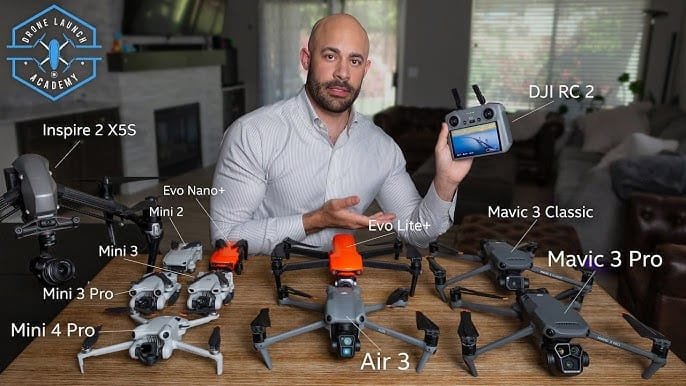
The best Mini Drone is light, easy to control, safe for beginners, and fun indoors or outdoors.
A small drone can turn a dull afternoon into a fun flight lesson. Yet many buyers worry about hard controls, weak batteries, poor video, or a drone that breaks after one crash. I tested these concerns against the features offered by six popular models. This guide helps you choose the right Mini Drone for a child, beginner, traveler, or serious camera user.
DJI Mini 4K: Best Camera Mini Drone

The DJI Mini 4K is the strongest choice here for shoppers who want a real camera drone in a small body. Its 4K video, GPS flight support, and gimbal system give it a more polished feel than most toy-grade models. The under-249-gram design also makes it easier to carry in a small bag. I like this balance because the drone feels serious without becoming bulky.
This Mini Drone suits adults, travel fans, and new pilots who want room to grow. Its automated flight tools can help with takeoff, landing, return, and simple shots. Still, it needs more open space than an indoor nano drone. The camera also performs best in good light, as expected from a compact consumer drone.
Pros:
- Sharp 4K video for travel and outdoor clips
- Lightweight body under 249 grams
- Gimbal helps keep footage smooth
- GPS support adds safer flight control
- Longer range than basic toy drones
- Foldable design fits well in travel bags
Cons:
- Costs more than simple beginner drones
- Needs open outdoor space for safe use
- Wind can affect any small, light drone
Veeniix V995: Best Mini Drone for Kids

The Veeniix V995 focuses on easy fun rather than advanced video work. It offers auto hover, headless mode, 3D flips, 360-degree rotation, and circle flight. These modes give new pilots quick wins, which can make the first flight less stressful. The included three batteries are also helpful because young users often want to keep flying after one charge ends.
Ready to find your next drone? Start with our guide to the best drones for every use.
This model works well as a first Mini Drone for indoor play and light outdoor use. Its small frame is easier to manage around a room than a camera drone. I would still use it away from fans, pets, glass, and stairs. The V995 is best viewed as a skill-building toy, not as a tool for high-quality aerial filming.
Pros:
- Simple controls for children and new pilots
- Three batteries extend play time
- Auto hover helps reduce sudden drops
- Headless mode lowers the learning curve
- Flip and circle modes add fun
- Compact size works well indoors
Cons:
- Not designed for sharp aerial video
- Small drones can drift near moving air
- Children need adult guidance during early flights
DJI Mini 4K Combo: Best for Long Flights

The DJI Mini 4K Combo gives buyers the same compact camera focus as the standard version, while adding a second battery. The listing states up to 62 minutes of total flight time, though real use varies with wind, temperature, speed, and battery habits. A three-axis gimbal supports smoother clips than a fixed toy camera. The result is a better setup for trips, events, and repeated practice.
I see this Mini Drone as a smart pick for someone who dislikes waiting between flights. Two batteries let you land, swap power, and continue with less delay. The 4K camera is useful for wide views, short travel clips, and simple social content. Buyers should remember that battery time is not the same as one nonstop flight.
Pros:
- Two batteries reduce charging delays
- Up to 62 minutes of listed total flight time
- 4K camera captures detailed outdoor video
- Three-axis gimbal helps steady the view
- Foldable body is easy to pack
- Automated shots simplify creative flying
Cons:
- Higher price than basic toy models
- Extra batteries add weight to a travel kit
- Flight time drops in cold or windy weather
Holy Stone HS210: Best Indoor Mini Drone
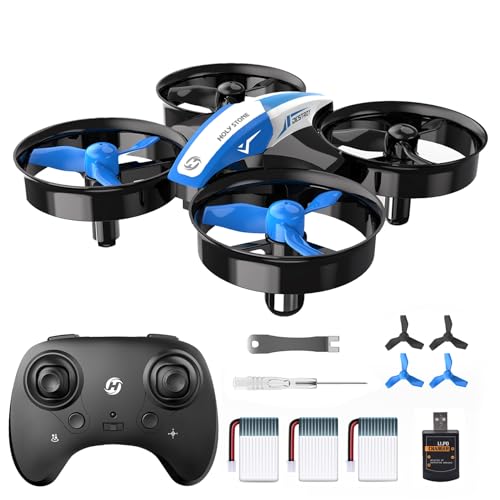
The Holy Stone HS210 is a tiny nano quadcopter built for simple indoor practice. It includes auto hovering, headless mode, and 3D flips, so a new pilot can learn basic movement without a long setup. Its small shape helps it fly in a bedroom, office, or living room with enough clear space. The three included batteries are a major benefit at this price level.
This Mini Drone feels more like a friendly flying toy than an outdoor aircraft. Its propeller guards can help during light bumps, but they do not make the drone crash-proof. I recommend using the slow speed mode first, then moving up when the pilot can control forward and side movement. It makes a fun gift for children who want an easy first step into drones.
Pros:
- Very small size for indoor practice
- Three batteries support longer play sessions
- Auto hover helps beginners learn control
- Headless mode makes direction easier
- Flip mode adds simple tricks
- Good gift choice for young beginners
Cons:
- Short flight time per battery is normal
- Not suited to strong outdoor wind
- Small body may be hard to see in dim rooms
1080P Foldable Drone: Best Budget Camera Pick

This foldable Mini Drone targets beginners who want a camera without paying for a premium aircraft. It offers 1080P video, one-key start, altitude hold, 3D flips, and two batteries. The foldable frame makes it simple to store in a drawer or carry on a short trip. These features create a broad mix of play value and basic recording.
I would choose this model for casual users who want to try aerial video at a low cost. The 1080P camera can record fun moments, but buyers should keep expectations realistic. Budget drone cameras often show softer detail and more shake than a gimbal camera. It is a practical bridge between a toy drone and a more advanced camera model.
Pros:
- Lower cost than premium camera drones
- 1080P camera supports basic video capture
- Foldable design saves storage space
- Two batteries extend the session
- One-key start simplifies takeoff
- Altitude hold helps steady beginner flights
Cons:
- Video quality is below a true 4K gimbal drone
- Wind may push the light frame
- Camera results depend on phone connection and light
Veeniix V995 Red: Best Value for Trick Flights

The red Veeniix V995 offers the same playful idea as the other V995 listing, with a bright color that is easy to spot during indoor use. It includes 3D flips, 360-degree rotation, circle flight, auto hover, and headless mode. The three batteries are listed for up to 21 minutes of combined flight time. That package gives a child many ways to practice and play.
This Mini Drone is a good fit for families who want movement, tricks, and quick learning. I like headless mode for the first few flights because it removes some of the confusion caused by the drone turning around. The red shell may also make it easier to track against a pale wall or floor. As with any small quadcopter, it needs a clear area and gentle control near furniture.
Pros:
- Bright red color improves visibility
- Three batteries offer up to 21 minutes combined time
- Several trick modes keep play fresh
- Auto hover helps new pilots
- Headless mode supports early learning
- Compact size works well inside
Cons:
- Not intended for professional video
- Indoor air movement can affect control
- Young children may still need close supervision
My Recommendation
After comparing these models, I would start with the DJI Mini 4K for adults who care about image quality, range, and long-term use. It has the strongest camera package and a more capable flight system. For a child’s first Mini Drone, I prefer the Holy Stone HS210 or Veeniix V995 because both focus on easy controls and fun tricks. The budget 1080P model sits between those groups and gives casual users a simple way to try aerial video.
Think about where the drone will fly before you buy. Indoor pilots need a small, guarded model with auto hover. Travelers need a foldable body and strong camera. Families should value extra batteries because children rarely want to stop after one short flight. Also check local rules before outdoor use, even when a drone weighs less than 249 grams, because weight does not remove every safety or airspace duty.
| Best for | Why |
|---|---|
| Travel video | DJI Mini 4K offers 4K video, a gimbal, and a light foldable body. |
| Kids and first flights | Holy Stone HS210 and Veeniix V995 offer auto hover, headless mode, and tricks. |
| Budget camera practice | The 1080P foldable drone adds basic recording, two batteries, and easy controls. |
How to Choose the Best Mini Drone
Choosing a Mini Drone starts with the place where you plan to fly. A nano model may work in a room, while a GPS camera drone needs a clear outdoor area. A small size does not mean every drone is safe for indoor use. Propeller guards, low-speed settings, and stable hover matter more inside than a long control range.
Next, decide if you want a toy, a learning tool, or a camera aircraft. Toy drones focus on flips, lights, and simple control. Camera drones focus on image quality, flight stability, and smart flight modes. A buyer who only wants family fun should not pay extra for features they may never use.
Camera Quality
Camera terms can sound bigger than the final result. A 4K label means the camera can record a high-resolution image, but it does not guarantee smooth or bright video. A gimbal helps by keeping the camera level as the drone moves. A fixed 1080P camera can still be fun for short clips, yet it may show more shake.
For travel, look for a stable camera, a good phone app, and a simple way to save files. For children, a camera may add cost without adding much value. In my view, camera quality should match the person flying the drone, not just the product title.
Flight Time and Batteries
Mini drones use small batteries because their frames are light. That keeps the drone nimble, but it limits each flight. Wind, cold air, fast speed, and repeated tricks can reduce the real flight time. This is why two or three batteries often matter more than a large number on a product page.
Always charge batteries with the supplied charger or a compatible charger made for that model. Do not leave a charging battery alone. Let it cool after flight, and store it in a dry place away from heat. These simple habits can help the battery last longer and reduce risk.
Ease of Control
New pilots often struggle with direction. When the front of a drone faces the pilot, left and right can feel reversed. Headless mode can reduce this issue by making control depend on the pilot’s view. It is useful at first, but I still recommend learning normal mode over time.
Auto hover is another key feature. It helps the drone hold its height when the pilot releases the throttle. It does not stop drift, wind movement, or every crash. A calm room, slow mode, and wide open floor will help more than any single feature.
Safety and Local Rules
A Mini Drone has fast-spinning propellers. Keep fingers, hair, pets, and loose clothing away from them. Children should fly with an adult nearby, even when the drone looks like a small toy. Remove fragile items from the room before the first flight.
For outdoor use in the United States, check current FAA guidance before takeoff. Recreational pilots may need to follow airspace limits, remote identification rules, registration rules, and safety requirements based on the aircraft and flight. A drone weighing under 249 grams can have fewer registration duties in some cases, but that does not mean every flight is free of rules. Rules can change, so check the current official guidance before flying.
Durability and Repairs
Small drones can survive light bumps when they have guards and a flexible frame. No model should be treated as crash-proof. Hard falls can damage motors, arms, cameras, or battery contacts. Flying over carpet or grass can soften a beginner mistake, while tile and concrete can turn one mistake into a repair bill.
Before buying, check if replacement propellers and batteries are easy to find. A low-cost drone can become poor value when one small part ends the whole flight. Extra guards and spare blades are wise for kids. I also suggest keeping the box for storage and reading the setup guide before changing any settings.
Mini Drone Features That Matter Most
Many product pages list a long set of flight modes. Some matter every day, while others may be used only once. Auto takeoff and landing help new pilots. Altitude hold helps steady the craft. Headless mode helps with direction, and emergency stop can limit damage during a bad flight.
Flips and circle flight are fun, but they use battery power and need clear space. GPS return-to-home is more useful for outdoor camera drones than for small indoor toys. A phone app can add photos and video, but the connection may depend on distance, walls, and local wireless noise.
Who Should Buy a Toy-Style Drone?
A toy-style Mini Drone is best for a child, a first-time pilot, or anyone who wants low-cost fun. These models are usually small, light, and easy to store. They can teach basic movement without the fear of damaging an expensive camera aircraft. Their limits are fair when the buyer understands the purpose.
Do not expect a toy model to hold a steady position outside on a windy day. Do not expect its camera to match a phone or a DJI gimbal. Think of it as a flying game controller with a learning curve. That view makes the purchase feel more honest and more rewarding.
Who Should Buy a Camera Drone?
A camera Mini Drone is better for travel, real estate practice, journalism, outdoor clips, and creative hobbies — making it one of the best drones for journalism work. It usually offers better control, a stronger connection, and a more stable camera. GPS can support position hold and return functions, but pilots still need to watch the aircraft at all times.
Camera drones also need more care. The lens must stay clean, the propellers must stay straight, and the pilot must avoid poor weather. They may be small, but they are not indoor toys. If you want a drone for a birthday gift, choose a toy model unless the child already has adult supervision and flight experience.
Tips for the First Flight
Charge the drone, controller, and phone before flight. Read the quick-start guide and install the app only from a trusted store. Check that the propellers sit in the correct positions. A wrong propeller can make a drone spin or fail to lift.
Start in a wide, calm area. Use the lowest speed mode, rise only a few feet, and practice forward, back, left, and right movement. Land before the battery becomes fully empty. The first flight should feel like a short lesson, not a race.
Keep the drone within sight. Avoid roads, crowds, power lines, airports, and private areas where people may expect privacy. Never aim a camera at a person’s window or private space. Good flying is calm, aware, and respectful.
Common Buying Mistakes to Avoid
The first mistake is choosing by camera resolution alone. A cheap drone may list 4K or even claim 8K like the Lanus Triple Camera 8K Drone, yet use a shaky fixed camera with weak image quality. Look at the full package, including gimbal support, control range, battery count, and app quality. A lower-resolution camera with stable flight may produce a better clip.
The second mistake is ignoring the battery count. A drone with one small battery may provide only a few minutes of fun before charging. Extra batteries cost money when bought later. Bundles can offer better value if the buyer plans to fly often.
The third mistake is buying an outdoor drone for indoor use. GPS models need room and may move faster than expected. Tiny guarded drones are safer for rooms, but they still need space. Match the model to the room, yard, and skill level.
The last mistake is skipping local rules. A light drone still has a camera, propellers, and access to shared airspace. Learn the current rules before the first outdoor flight. A few minutes of planning can prevent a costly and unsafe mistake.
FAQs Of Mini Drone
Is a Mini Drone good for beginners?
Yes. Small drones with auto hover, headless mode, and low-speed settings are often easy to learn. Start indoors with a guarded toy model or outdoors in a calm, open area. Practice basic movement before using flips or fast mode.
Can a Mini Drone fly outside?
Some can, but wind is the main limit. Light nano drones work best indoors or on calm days. Larger camera models handle outdoor use better, but every pilot must follow current airspace and safety rules.
How long does a Mini Drone battery last?
Flight time depends on the model, speed, wind, temperature, and battery age. Toy drones often provide short flights per battery. Bundles with two or three batteries can offer a longer play session with fewer breaks.
What is the safest Mini Drone for kids?
Look for propeller guards, auto hover, low-speed mode, and simple controls. The Holy Stone HS210 and Veeniix V995 are good examples of beginner-focused designs. Adult supervision remains important, especially during indoor flights.
Do I need to register a Mini Drone?
Registration depends on the drone, its weight, its use, and current local rules. In the United States, a drone under 249 grams may have different registration treatment than a heavier aircraft. Check the latest official FAA guidance before flying outdoors.
Final Verdict: Which Should You Buy?
The DJI Mini 4K is the best Mini Drone here for adults who want clear 4K video and dependable outdoor features. For kids, the Holy Stone HS210 offers the easiest indoor start, while the Veeniix V995 adds more tricks and three batteries.
Choose by skill, space, and camera needs. The right Mini Drone makes flying simple, fun, and safe from the very first launch.




[…] surveys. Fixed-point hovering allows precise data collection, crucial for accurate analysis. Drones like the CHICIRIS are becoming indispensable for scientists and conservationists. They offer a […]
[…] Educational drones help students understand technology, science, and math. They provide hands-on learning opportunities, enhancing creativity and problem-solving skills. Books like “Legislação de Aerolevantamento e Drones” and “Rourke Educational Media Drones (How It Works)” offer valuable insights into drone use. […]
[…] tasks. Drones can access hard-to-reach areas, ensuring safety and precision. One such device is the Drone Airdrop System Universal, which can carry up to 1. 6 pounds. This payload capacity allows for transporting small tools or […]