


The best router for power users is the D-Link DIR-878 for fast dual-band networking, MU-MIMO, and steady daily performance.
A busy home network can feel slow even when your internet plan is fast. Many devices compete for bandwidth while video calls, gaming, 4K streaming, smart home gear, and large downloads run at the same time. I reviewed the supplied products with that real problem in mind. The list includes Wi-Fi routers, a 4G LTE router, woodworking routers, and UPS units that protect networking equipment. Only some are network routers, but each may matter to a power user who wants a reliable, complete setup.
See the differences between my top picks at a glance.
D-Link DIR-878 AC1900 Wi-Fi Router

The D-Link DIR-878 is the clearest match for this review’s main topic. It is a dual-band AC1900 wireless router built for homes with many connected devices. Its product listing highlights MU-MIMO support and a dual-core processor. Those features help it serve several clients with less delay than a basic, low-cost router.
I like this model for people who want a traditional router that can handle gaming, streaming, work calls, and smart home traffic in one network. It does not offer the newest Wi-Fi 6 or Wi-Fi 7 standard, so buyers with very fast multi-gigabit internet should look at newer hardware. Still, its AC1900 class, wired Ethernet ports, and dual-band design make it a practical choice for many homes.
Pros:
- Dual-band wireless design for better device distribution
- MU-MIMO support for simultaneous client connections
- Dual-core processing for routine network tasks
- Useful fit for gaming and 4K streaming homes
- Four external antennas help support broad home coverage
- Simple choice for users who want a normal home router
Cons:
- Uses Wi-Fi 5 rather than newer Wi-Fi 6 or Wi-Fi 7
- Performance depends on walls, distance, and client devices
- Advanced users may want stronger modern control features
What Amazon Buyers Are Saying
Buyer feedback for this type of D-Link router commonly centers on easy setup, good range, and reliable service for everyday streaming. Users who replace older entry-level routers often notice a better experience with several devices online. Reviews also tend to show that results vary by home size and wall layout.
Some buyers report setup or firmware concerns, which is normal to check with any network product. A few users expect enterprise-level controls from a consumer router and feel limited by that approach. I recommend reading recent reviews for current firmware behavior and checking whether your internet plan needs Wi-Fi 6 or faster.
My Recommendation
I recommend the DIR-878 as the best direct network-router choice in this group. It offers a good balance of wireless capacity, familiar setup, and useful features. It is worth buying when the price is attractive and your devices support Wi-Fi 5. I would not choose it for a new multi-gigabit home that needs the latest wireless standard.
GC111 Industrial 4G LTE CPE Router

The GC111 serves a different need from the D-Link. It is an industrial-grade 4G LTE CPE router that uses a SIM card for cellular internet access. The listing describes a tough iron case, support for up to 32 Wi-Fi users, four RJ45 ports, and large SMA antenna connections. That makes it interesting for remote sites, temporary offices, workshops, and backup internet plans.
This is not the first pick for a standard fiber or cable home network. It depends on cellular coverage, carrier support, SIM activation, and local network bands. Its value rises when wired broadband is weak or unavailable. A power user may also pair it with a normal Wi-Fi system as a failover path, but compatibility and setup require careful checking.
Pros:
- Provides internet through a compatible 4G LTE SIM
- Useful for rural, mobile, or temporary work locations
- Industrial case may suit demanding environments
- Four RJ45 ports support wired equipment
- External SMA antenna connections can aid difficult signal areas
- Listed support for up to 32 Wi-Fi users
Cons:
- Cellular speed changes with signal strength and network load
- Carrier bands and SIM compatibility need checking first
- May need a separate access point for larger Wi-Fi homes
What Amazon Buyers Are Saying
Feedback on 4G CPE products often focuses on signal performance, carrier setup, and the usefulness of external antennas. Buyers who need internet outside a cable or fiber area tend to value the flexible SIM-based design. Users also look for stable Ethernet service and a case that can handle a less controlled location.
The main complaints with cellular routers usually involve carrier compatibility, unclear band support, or speeds that do not match wired broadband. That does not always indicate a bad router; cellular conditions vary greatly. Check the seller’s current technical details and your carrier’s approved device rules before ordering.
My Recommendation
I recommend the GC111 for a power user who needs cellular connectivity or a backup path. It is not the best main router for a typical broadband home, but it can solve a serious access problem. Buy it only after confirming LTE bands, SIM requirements, power needs, and antenna options in your area.
APC BE850G2 UPS for Router and NAS

The APC BE850G2 is not a router. It is a UPS, or uninterruptible power supply, made to protect electronics during power cuts and electrical events. Its listed capacity is 850VA and 450 watts, with nine outlets and two USB charging ports. For a power user, that capacity can keep a modem, router, switch, NAS, and small network devices running for a short time.
This product matters because even the best router for power users fails when its power source drops. The listed runtime is 35 minutes at a 100-watt load, but actual runtime changes with the equipment connected. I like the extra outlets for a network shelf or home office. Do not connect high-draw devices such as heaters or printers to the battery-backed outlets.
Pros:
- Higher 850VA/450W capacity than the smaller APC option
- Nine outlets help support a larger network setup
- Two USB charging ports add useful flexibility
- Designed for computers, routers, and NAS devices
- Can reduce downtime during short utility outages
- Useful for protecting network storage from sudden shutdowns
Cons:
- Does not provide Wi-Fi or routing by itself
- Battery runtime falls as connected wattage rises
- Battery replacement adds a future ownership cost
What Amazon Buyers Are Saying
Buyers commonly value the BE850G2 for its outlet count, compact home-office format, and ability to keep key devices alive during short outages. Network users often like placing the modem and router on battery power instead of losing internet at the first flicker. The display and power management features also appeal to people who track their equipment.
Common concerns include alarm noise, battery life over time, and the difference between advertised runtime and real use. UPS runtime always depends on load, battery age, and line conditions. I suggest testing your actual router stack after installation and replacing the battery when the unit reports reduced capacity.
My Recommendation
The BE850G2 is my preferred power accessory in this list. It cannot replace a router, but it can make a home network far more dependable. I recommend it for power users with a modem, router, NAS, switch, or home server. It is worth the added cost over a small UPS when you need more outlets and reserve capacity.
APC BE600M1 Compact UPS
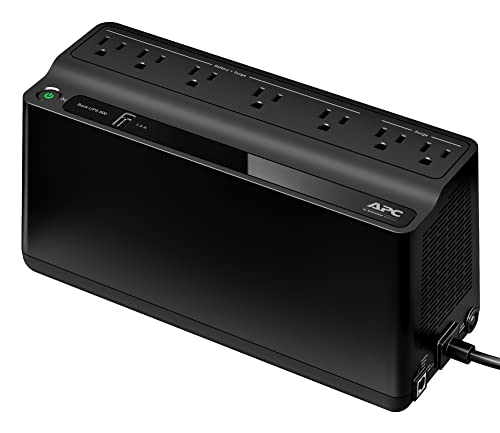
The APC BE600M1 is a smaller UPS for a simple network station. It provides 600VA and 330 watts of backup capacity, plus a USB charging port. The listing states up to 23 minutes at a 100-watt load, along with surge protection. This capacity can suit a modem, router, and one small network accessory.
I see this model as a practical entry point for protecting internet access. It takes less space than a larger battery unit and may cost less. The trade-off is lower capacity and fewer outlets than the BE850G2. If your setup includes a NAS, desktop PC, or several network devices, measure the total load before choosing this compact model.
Pros:
- Compact 600VA/330W design
- Good fit for a modem and home router
- USB charging adds daily convenience
- Surge protection helps guard connected electronics
- Listed runtime of 23 minutes at a 100-watt load
- Simple way to reduce short network interruptions
Cons:
- Less capacity than the BE850G2
- Fewer outlets for a large power-user setup
- Not a replacement for a generator during long outages
What Amazon Buyers Are Saying
Amazon buyers often choose the BE600M1 because it is small, familiar, and easy to place beside a desk or network shelf. Users commonly appreciate having enough backup power for a router and modem during short outages. The USB port also receives attention from people who want to charge a small device nearby.
Some buyers find that runtime drops when they add a computer or other power-hungry equipment. Others mention battery replacement after extended use. Those points match the limits of a 330-watt UPS. I would use it for essential network gear, not for a full workstation and several accessories.
My Recommendation
The BE600M1 is worth buying for a small network and a modest budget. It is the better compact choice when you only need to keep internet access alive during brief outages. Pick the BE850G2 instead if you run a NAS, desktop, switch, or several wired devices.
BOSCH 18V Cordless Wood Router

The BOSCH GKF18V-25N is a woodworking router, not a networking device. I include it because the supplied product list uses the word “router” in two different ways. This model is a cordless palm router with a brushless motor, variable speed control, and a dust extraction system. It targets trim work, edge shaping, and other small woodworking tasks.
The cordless format can make work easier when a power cord gets in the way. It also suits job sites where outlet access is limited. Buyers must account for the battery and charger system, since tool-only kits may not include them. If your goal is home internet, this product is the wrong category; if your goal is precise woodwork, it may be the most refined tool here.
Pros:
- Cordless design improves movement around a workpiece
- Brushless motor design aims for efficient tool operation
- Variable speed control supports different bit and material needs
- Dust extraction helps manage chips during use
- Compact palm-router form suits trim tasks
- Useful option for users already invested in the BOSCH 18V system
Cons:
- Not a Wi-Fi, broadband, or cellular router
- Battery and charger availability must be checked
- Runtime depends on battery size and cutting load
What Amazon Buyers Are Saying
Feedback for cordless palm routers usually focuses on balance, handling, power, and battery convenience. Woodworkers often like removing the cord from trim work and small projects. Buyers also pay close attention to the quality of the base, speed control, and dust collection connection.
Typical concerns include battery cost, runtime, and the limits of a compact router on heavy cuts. Those are reasonable trade-offs for a cordless palm tool. I suggest checking the kit contents and using the right bit, speed, and feed rate for the material.
My Recommendation
I recommend the BOSCH for woodworking users, not networking users. It appears to be a strong fit for trim and detail work when you already own compatible batteries. It should not influence your choice of the best router for power users in a home internet search.
AVID POWER 1.25 HP Compact Wood Router

The AVID POWER 6.5-amp compact router is another woodworking tool. Its listing gives it a 1.25 HP motor, six variable speeds, a fixed base, trim router bits, edge and roller guides, and a dust hood. These features target makers who need to trim edges, cut grooves, and shape wood with a small corded tool.
A corded motor removes battery limits, which can help during longer projects. The fixed base also gives a beginner a more direct setup than a large plunge router. Still, this tool needs safe handling, eye protection, hearing protection, and a secure workpiece. It has no role in Wi-Fi or internet routing, despite the shared product name.
Pros:
- 1.25 HP motor suits many small woodworking jobs
- Six variable speeds offer useful control
- Fixed base provides a stable trim platform
- Includes guides and a dust hood
- Trim bits add value for new woodworkers
- Corded operation supports longer work sessions
Cons:
- Not a home networking router
- Cord can limit movement around a large workpiece
- Compact design may not suit deep or very heavy cuts
What Amazon Buyers Are Saying
Buyers of compact corded routers often value the included accessories, variable speed, and low entry cost. New users may like having guides and bits in one package. Experienced woodworkers tend to judge the tool by base stability, speed control, collet fit, and long-term durability.
Some reviews for budget woodworking tools mention rough edges in accessories, dust collection limits, or a learning curve. Those points are worth considering before demanding professional-level results. I would inspect the bit fit, tighten the collet correctly, and make test cuts before working on a finished project.
My Recommendation
This AVID POWER model is a reasonable value for occasional woodworking and trim work. It is not relevant to a wireless network purchase, so do not confuse it with a networking router. Choose it only if you need a corded woodworking tool and accept the limits of a compact budget model.
AVID POWER 630W Compact Palm Router

This AVID POWER model is a 630-watt, 5.3-amp palm router for woodworking. The listing highlights a fixed base, trim bits, a 1/4-inch collet, straight and roller guides, two wrenches, carbon brushes, and a listed speed of up to 35,000 RPM. It targets light trimming, edge work, and small craft projects.
The palm shape can feel easy to guide, especially for a user who does not need a large router. A fixed base keeps the tool focused on surface work rather than plunge cuts. It is a corded tool, so it avoids battery charging but needs a safe cable path. As with the other tool listings, it is unrelated to home networking.
Pros:
- Compact palm shape supports controlled trim work
- 630-watt motor suits light woodworking tasks
- 1/4-inch collet fits common trim-router bits
- Includes straight and roller guides
- Fixed base keeps setup simple
- Carbon brushes may help with basic service needs
Cons:
- Not suitable as a Wi-Fi or broadband router
- Compact motor has limits on hard, deep cuts
- High listed speed calls for careful bit selection and control
What Amazon Buyers Are Saying
Users shopping for compact palm routers often look for low weight, easy control, and useful included accessories. Buyers may appreciate a ready-to-use kit for small furniture repairs, shelves, signs, and edge profiles. The guide options can help users create more even cuts when they set the tool correctly.
Budget-tool reviews often raise questions about accessory quality, noise, and long-term use. A compact router also demands care because a high-speed bit can damage wood quickly. I recommend practicing on scrap stock and checking every fastener before each cut.
My Recommendation
I recommend this model for light woodworking on a budget, especially when a small fixed-base tool is all you need. I do not recommend it for anyone searching for a network router. The correct choice depends on whether “router” means internet hardware or a cutting tool in your project.
How to Choose the Best Router for Power Users
Choosing the best router for power users starts with the kind of router you need. In networking, a router directs internet traffic between your modem, local devices, and outside services. In woodworking, a router spins a cutting bit. The supplied products include both meanings, so I would confirm the category before comparing price or features.
1. Match the Router to Your Internet Service
For a home network, check your internet speed, connection type, and number of clients. A dual-band Wi-Fi 5 router such as the D-Link DIR-878 can suit many homes with cable or standard fiber plans. If you own newer Wi-Fi 6 or Wi-Fi 7 devices, a current router may offer better efficiency and longer service life.
Power users should also count wired devices. A gaming PC, NAS, desktop, network switch, smart TV, and access point may benefit from Ethernet. Wi-Fi speed on a product box does not equal real internet speed. Walls, interference, distance, client radios, and the internet plan all affect results.
2. Plan for Load, Coverage, and Backup
MU-MIMO can help a router communicate with more than one compatible device at a time. It does not fix every slow connection, but it can help in a busy home. Place the router in an open, central spot. If one unit cannot cover the space, consider a mesh system or a wired access point instead of simply buying a router with a larger speed number.
Power continuity also matters. A UPS can keep the modem and router online during a short outage. The APC BE600M1 fits a small setup, while the BE850G2 offers more capacity and outlets. A cellular router such as the GC111 can provide another internet path, but it needs suitable carrier coverage and a compatible SIM.
3. Compare Controls, Support, and Total Value
Look for the features you will use. Guest Wi-Fi, automatic updates, device controls, traffic rules, VPN support, and clear status tools can matter more than a high headline speed. Check the maker’s support page for firmware history and setup guides. Also confirm warranty terms and return options before purchase.
Think about total cost. A router may need a modem, mesh node, Ethernet switch, UPS, or subscription service. A cellular model may add monthly data fees. A woodworking router may need batteries, bits, dust collection, and safety gear. The best router for power users is the one that fits the full system, not just the product title.
Final Verdict: Which Should You Buy?
For home networking, the D-Link DIR-878 is the best direct choice in this group. Choose the APC BE850G2 to protect it, or the GC111 when cellular backup matters.
The best router for power users should match your speed, device count, coverage, and uptime needs. Check compatibility before buying, and do not confuse a network router with a woodworking router.
FAQs Of Best Router for Power Users
What is the best router for power users in this review?
The D-Link DIR-878 is the best direct networking choice here because it offers dual-band AC1900 wireless, MU-MIMO, and a dual-core processor.
Is the D-Link DIR-878 a Wi-Fi 6 router?
No. The DIR-878 is a Wi-Fi 5, or 802.11ac, router. Buyers with newer devices may prefer a Wi-Fi 6 or Wi-Fi 7 model.
Can a UPS improve my router’s internet speed?
No. A UPS does not increase speed. It keeps the modem and router powered during short outages and helps protect connected equipment.
Is the GC111 4G router good for home internet?
It can work well where cellular coverage is strong and the SIM and LTE bands are compatible. Confirm carrier support before buying.
What is the difference between a network router and a woodworking router?
A network router directs data between devices and the internet. A woodworking router spins a cutting bit. They are completely different products.






